
During my undergraduate studies, I remember seeing a name on the cover of Luis de Góngora’s sonnets and having no idea how to pronounce it. That’s how I first came across Birutė Ciplijauskaitė, the editor of one of Spain’s foremost poets, whose name struck me as utterly impossible. If I’m honest, I don’t think I gave it much thought at the time; after all, I’m a Scot studying Spanish Renaissance poetry. Visokių žmonių reikia!
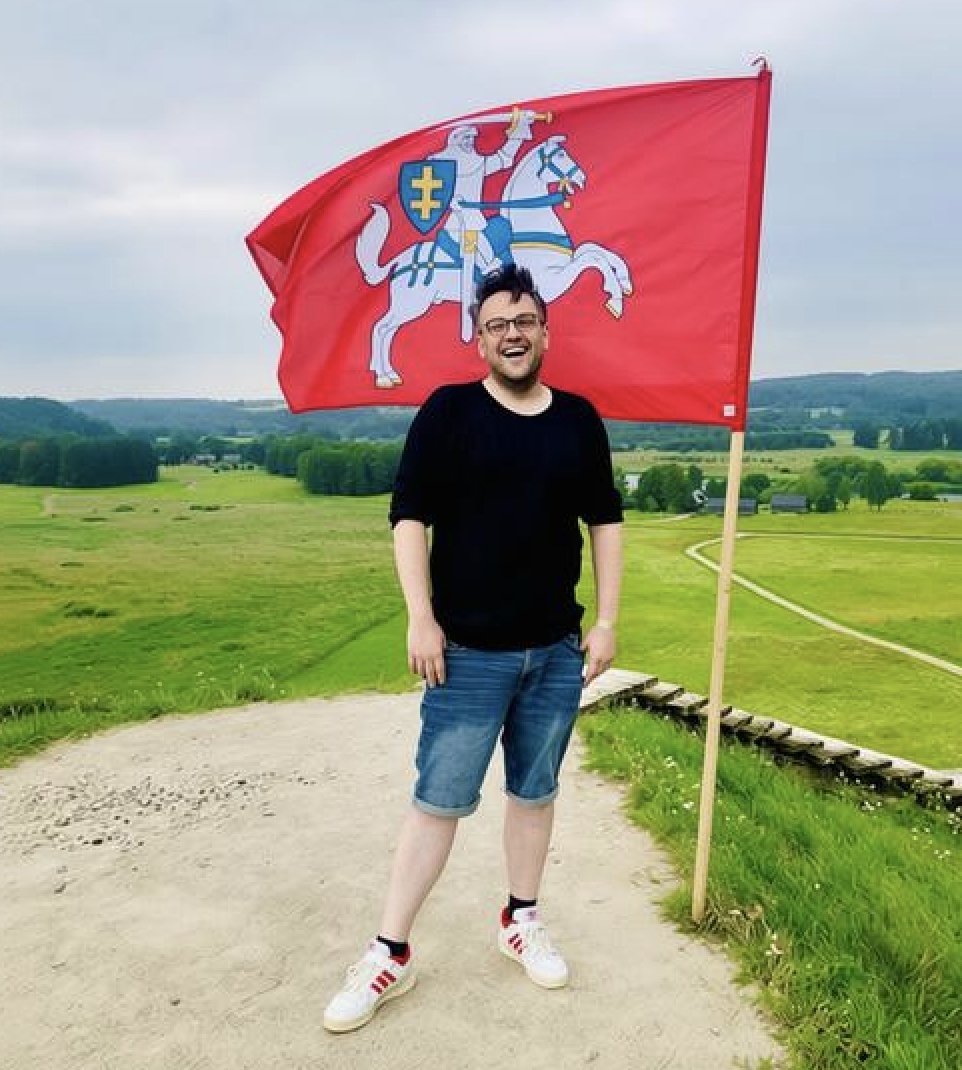
In August 2025, I arrived at UW–Madison as a Birutė Ciplijauskaitė Fellow in Spanish Literature to work on my second book. Alongside invaluable time to read, think, and write, I even convinced my employer to spell my fellowship’s namesake properly, using the most Lithuanian letter of them all: ė. Colleagues joke that not since Birutė herself has anyone come quite so close to pronouncing her name correctly. Mano maža pergalė!
My research here in Madison has involved writing about the marriage poetry of three Luso-Iberian poets: Juan Boscán (Spain), António Ferreira (Portugal), and Eugenio de Salazar (colonial Mexico). Instead of repeating Francesco Petrarca’s familiar model of torment and unattainable desire, my findings highlight that sixteenth-century Luso-Iberian writers forged an innovative poetics of marriage that showed love as an ethical practice, reshaping ideals of manhood in the process.
None of this research would have been possible without Birutė’s gift to UW–Madison after her passing in 2017. Born in Kaunas in 1929, she fled Lithuania during World War II, completed her studies in the United States, specialising in French and Spanish, and joined UW–Madison in 1961, where she worked until her retirement. In addition to being one of the most prominent Hispanists in America, she also published on contemporary Lithuanian literature and advised on the cultural journal Lituanus.
One day, I hope to learn enough Lithuanian to take on a research project closer to home, building on the foundations I gained in Vilnius, which finally let me say Birutė’s name correctly. At the turn of the twentieth century, thousands of Lithuanians migrated to Lanarkshire (Scotland), where I grew up, to escape Tsarist rule. They mined coal, worked iron and steel, and built railways, with many choosing to stay and make lives for themselves instead of continuing to the United States. Long since integrated, these communities are unusually well-documented for the period, including through Lithuanian-language newspapers. Their contribution to Scotland’s industrial past deserves to be better recognised.
As my time in Madison draws to a close, I count myself lucky not only to have had the opportunity to focus on my research thanks to the Birutė Ciplijauskaitė Fellowship, but also to have been part of the Lithuanian community here. Many of you have contributed to making my time in this corner of the world such a memorable experience. Whether it was my first football game (On Wisconsin!), hiking and swimming at Devil’s Lake, or tasting the divine ambrosia that is Culver’s frozen custard, I’ve had an absolute blast! Ačiū jums už viską!
